


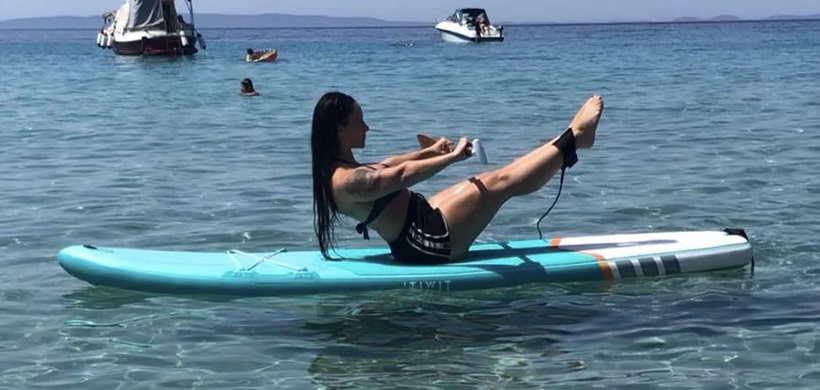
SUP recreation… We’ve been taking it with us to the sea for several years, and its use is versatile, including for sunbathing, among other things. Personally, it is not difficult for me to practice soup. This is because I do a lot of balance exercises in the gym. But for me, swimming is an excellent addition to exercise because of the environment and the water.
What can we do with soup and its positive sides?
Constantly trying to maintain balance on the sup board activates most of the muscles in the body. For rowing in addition to legs, arms, back, etc. we use the stabilizing muscles of the trunk and joints the most, as they keep us balanced. An added benefit of SUP is that you are unlikely to damage the tendons and ligaments of your joints, at most you will only strengthen them. Therefore, I can say that it is also suitable for post-rehabilitation. Swimming is a combination of aerobic training and strength training. In the beginning, you may fall several times when trying to stand up, but with persistence, you will soon achieve an improvement in balance. Various organized group exercises are performed at the soup, including yoga and also individual exercises. On this miraculous sea carpet, we can do very high-quality training for the whole body. Examples of exercises that I perform are squats, push-ups, and plank,…
And a short jump into the history of supping:
- 3000 BC a Peruvian fisherman rowed on his knees and stood up when he caught a wave.
- Boards made of reeds were called TUP (quite close to SUP!).
- The Bible claims that in 1275 BC. n. no. the daughter of the Egyptian pharaoh Queen Bithia stood up on the boat to get a better view as she searched for Moses (the Savior of the Jews).
- 400-900 Polynesians develop stand-up surfing as a recreational/cultural practice. Apparently, only the king was allowed to drive expensive long planks that could be stood on. Ordinary Hawaiians rode cheaper shorter boards (circa 1850).
- Bamboo drifting in 500 – China – a monk on a reed crossing a river, later followed by a single bamboo drift, which is now a cultural sport in China.
- Arab history, years 800 -1300 – Hasake, a board-boat hybrid from the Stand-up Paddle (SUP) family of boards, Israeli-Arabic roots, Hasakes were used primarily for fishing.
- In 1200 in Burma, one-legged fishermen rowed on one leg on Inle Lake.
- 1712 Report from the Gold Coast of West Africa describing recreational play in the waves, including rowboats.
- 1769 Matavai Bay, Tahiti – Recreational paddleboarding described by Joseph Banks (member of James Cook’s first Pacific expedition). In 1860, Mark Twain writes about recreational surfing in Polynesia.
- In 1869 Mark Twain writes about gondolas in Venice.
- 1912 Breakthrough in Australia – instead of all these open canoes, a closed hull is made that does not absorb water and stands on it. It’s called the Surfski and it’s built and driven for the first time in Australia.
- In 1939 The Surfski becomes most famous after being brought to Hawaii, where it was ridden by Duke Kahanamoku (the father of modern surfing).
- In 1945 John Zapozocky takes over stand-up rowing from Duke and uses single-bladed oars.
- In 1995 Laird Hamilton begins experimenting with long surfboards. Together with Dave Kalama, they start using oars.
- In 2001 The American brand ULLI uses drop stitch material to produce inflatable boards. The material was developed by the US Army in cooperation with the Goodyear Tire and Rubber Company. The US military abandoned the inflatable plane project (no one wanted to fly a plane that could be shot down with a bow and arrow). In 2008, inflatable stand-up paddleboards are becoming more and more popular.
- In 2002 Laird Hamilton rides a 6-foot south wave in Malibu with an American flag on a specially designed board and paddle (with a US flag) for stand-up paddling after experimenting and developing the sport of SUP since 1996. Hamilton and Dave Kalama developed SUP as a sport and spread it all over the world. Both watermen are living legends of the ocean and thanks to them modern SUP was born. It all started with a photo shoot for Oxbow in 1996. Dave had canoe paddles in his car and they started playing with them as there were few waves. They fell in love with the potential of paddling while standing on the board and couldn’t stop. After 20 years, millions of people around the world are recreating with SUP.”
For those who are interested in more – see Ben Marcus’ book (The Art of Stand up Paddling) for more details.